Better Plants will deliver a VT on Making the Business Case from September 22 to November 10, 2026. Participants will learn strategies on how to engage employees, effectively communicate project values, and use practical methods such as Life Cycle Assessment (LCA) and Technoeconomic Analysis (TEA) to secure management buy-in to implement energy productivity projects. The training will also include a demonstration of the JUSTIFI tool.
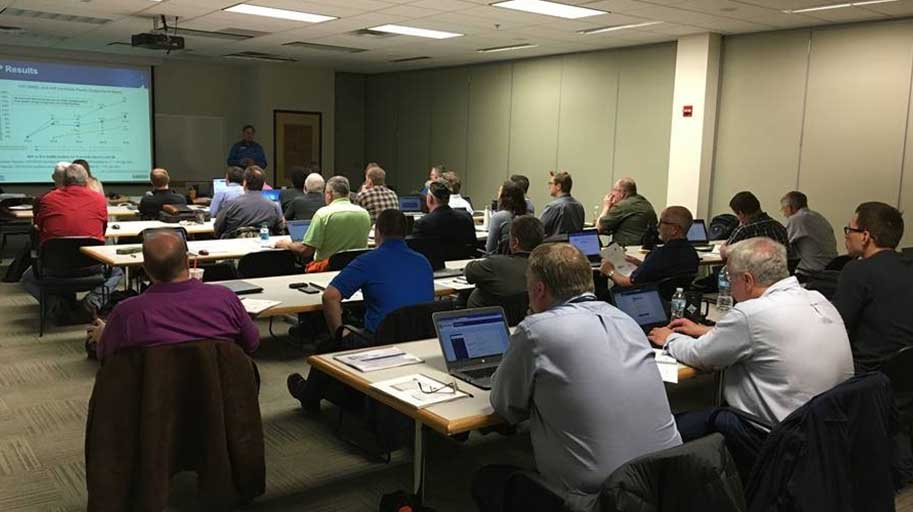
The Making the Business Case VT is comprised of 2-hour online training sessions (1.5-hour formal training and an optional 0.5-hour Q&A) that will be delivered by industrial experts and Technical Account Managers every Tuesday, 10:00 AM–12:00 PM ET for seven (7) weeks — with no session scheduled for November 3. Participation is open to all U.S. manufacturers and is offered at no cost.
To maximize the benefits from attending VTs, participants will receive homework assignments at the end of each session that will be due by the next session. These assignments are designed to enhance participants’ understanding of the concepts and tools and will help them design implementation plans for energy projects.
After completing the VT, participants may request a certificate for Professional Development Hours (PDHs). Participants will leave with practical strategies and actionable insights they can apply to understand, evaluate, and effectively communicate the total value of energy projects.

Sept 22 – Nov 10, 2026; Every Tuesday, 10:00 AM – 12:00 PM ET
Week 1 – Introduction and Employee Engagement for Energy Saving Projects; Sept. 22, 2026
A demonstration of the importance of a strong business case for energy savings projects. The session will include an introduction to the concepts of Life Cycle Assessment (LCA) and Technoeconomic Analysis (TEA), while highlighting the importance of employee engagement as a key driver of energy-productive initiatives.
Week 2 – Life Cycle Assessment (LCA) for Energy Projects; Sept. 29, 2026
An overview of how LCA is used to evaluate the effects of a process or product across its entire life cycle, including new technologies being considered for process improvement. The session will provide participants with an overview of key LCA concepts and discuss how LCA results can be used to support project implementation.
Week 3 – Technoeconomic Analysis (TEA) for Industrial Projects; Oct. 6, 2026
An explanation of how TEA is used to evaluate the economic and commercial performance of an industrial project or technology, translating technical and financial inputs into metrics such as minimum selling price, ROI, and payback period. The session will also include how to use both TEA and LCA to strengthen insights towards project success.
Week 4 – Beyond Energy Cost Savings: Foundations of Multiple Benefits; Oct. 13, 2026
An introduction to the concept of multiple benefits which encourages a broader assessment of the value and operational improvements that energy-related projects can provide beyond cost savings. The session also includes language for identifying and communicating multiple benefits (e.g., enhanced safety or lower maintenance costs) and how it aligns with broader business performance to position facilities for greater competitiveness.
Week 5 – Power Up the Business Case: Applying Multiple Benefits in JUSTIFI; Oct. 20, 2026
A review of the multiple benefits concepts where participants will have the opportunity to use an energy project from their own facility and work through a guided, hands-on session in JUSTIFI. Participants will learn to estimate operational and financial effects, quantify multiple benefits, and link improvements to performance metrics that demonstrate clear, defensible business value.
Week 6 – Communicating the Business Case: Presenting to Decision Makers; Oct. 27, 2026
An analysis of how to effectively communicate the analysis results to management to get buy-in, including how to structure an executive presentation, highlight key financial and operational benefits, anticipate common questions, and address concerns related to cost, risk, and implementation.
No Session; Nov. 3, 2026
Week 7 – Session Review and Participant Report-Outs; Nov. 10, 2026
A review of the key tools covered throughout the training, including participant report-outs on securing management buy-in and moving projects forward.
Mr. Tom Wenning
Thomas Wenning is a Program Manager for Industrial Energy Efficiency at Oak Ridge National Laboratory, leading domestic and international technical assistance, training, assessments, and technology deployment. Under his leadership, DOE’s Better Plants program has grown to more than 240 industrial partners, generating over $8.2 billion in cumulative energy savings. He also leads the modernization of DOE’s energy-system software, including the MEASUR suite, downloaded more than 25,000 times. A registered Professional Engineer and certified energy management specialist, Mr. Wenning has received national and international recognition, including awards from DOE, the Alliance to Save Energy, the Association of Energy Engineers, and CFE Media.
Dr. Dipti Kamath
Dr. Dipti Kamath is an R&D Associate Staff Member in the Manufacturing Energy Efficiency Research & Analysis Group at ORNL. At ORNL, Dipti works on the techno-economic and life cycle assessment of emerging technologies for industrial transformation, especially for the pulp and paper sector. She also serves as a Technical Account Manager for the DOE Better Plants program. Dipti’s research interest has been in sustainable energy systems, material efficiency, and alternative fuels. Dipti received her Ph.D. in Environmental Engineering with dual major in Environmental Science & Policy from Michigan State University; she received a Master of Technology in Environmental Engineering from the Indian Institute of Technology Delhi, and a Bachelor of Technology in Civil Engineering from the University of Calicut.
Sarah Cooney
Sarah Cooney serves as a Researcher in the Center for Energy Conversion & Storage Systems at the National Renewable Energy Lab in Golden, CO. She supports manufacturers, utilities, and education providers in their energy transition efforts, while also leading initiatives to quantify non-energy benefits for energy efficiency projects. She has experience specializing in Lean & Six Sigma methodologies, regulatory compliance, and project management. Sarah has held a variety of manufacturing and operations roles in several industries including chemicals, pharmaceutical, and automotive. Previously, she has held positions as Plant Manager, Director of Operations, and Vice President of Operations. Achieving operational excellence was a central accountability for these roles. She is passionate about leveraging her skills to drive innovation and efficiency in the renewable energy sector while fostering workforce development in clean energy initiatives.